Tuesday, January 23, 2007

Game Theory

"The Battle of Waterloo was won on the playing-fields of Eton” (attributed to the Duke of Wellington)
How do the games we Americans play influence us? The most popular game in the world is “football”, which Americans call soccer. One of the most popular games in America is “football”, a different game in which the foot rarely touches the ball. Let's compare these games.
  • Attention: Soccer has very few interruptions. Football is mostly interruptions. There are only about 5 seconds of activity in every 30 seconds of game time. There are also as many as 12 time-outs per game. A 90 minute soccer game takes about 2 hours. A 60 minute football game takes about 3 hours. Football cheerleaders may help regain flagging attention. The other great American pastime, baseball, is even worse in this respect. A baseball game is an eternity of near-perfect inactivity, interrupted with brief spasms of action by only a few of the players.
  • Identity: You can see the faces and bodies of the soccer players. Football players are helmeted and padded to such an extent that they can only be identified by their numbers.
  • Initiative: Soccer is free flowing, so individual improvisation and spontaneous cooperation are essential. In contrast, football is highly scripted. The responsibility for a football “play” is distributed among coordinators, coaches, and players.
  • Winning: Soccer is low scoring. There is no way to score more than 1 point at a time and even a single score can be crucial. There is no way to score only 1 point in football. Football scores are more than 10 times higher than soccer scores. Most important, soccer accepts a tie score while football goes to great lengths to avoid ties.
Soccer is better training for real life than is football. We need diligence, improvisation, cooperation, and personal responsibility to succeed in life. And success is often really just a battle to a draw against similarly motivated and inspired colleagues and competitors. Americans are trained to engage the world with the goal of winning, quickly, in a discrete round of negotiations or warfare. Instead, a long term, flexible engagement and accepting ties might be more appropriate and productive. And where are the cheerleaders in real life? Football is a great game but it may be poor preparation for life.

Monday, January 15, 2007

King Conscience

One year before he was murdered, Martin Luther King spoke out against America's war in Vietnam “because”, he said, “my conscience leaves me no other choice”. King was compelled to speak out against “the greatest purveyor of violence in the world today -- my own government.” It was a difficult decision because he alienated President Johnson, who advanced civil rights laws and applied Federal government power to protect civil rights. He also knew that his stance would risk dividing the civil rights movement. But he listened to his conscience.

The parallels with Iraq are striking.

The Iraqis, like King said of the Vietnamese, “must see Americans as strange liberators". We helped liberate the Vietnamese from Japanese imperialism only to allow the return of French colonialism. Similarly, we liberated the Iraq from decades of tyranny under Saddam Hussein only to allow it to descend into violence that eclipses even Saddam's reign.

The people of the Middle East today, just as King said of the Vietnamese then, “may have justifiable reason to be suspicious of the good faith of the United States”. Our overweening obsession with oil is self evident and morally blinding.

The Bush administration would substitute “anti-terrorism” for civil rights, yielding “peace and anti-terrorism don't mix”. King said those who offer such false choices “do not know the world in which they live”. Bush's blundering misadventures has cost America much of the admiration and trust of the rest of the world. This has made the world a more dangerous place for all free thinking people.

Rename the Baghdad “Green Zone” a big “hamlet” and this quote is accurate today in Iraq:
“Now there is little left to build on -- save bitterness. Soon the only solid physical foundations remaining will be found at our military bases and in the concrete of the concentration camps we call fortified hamlets.”
You can imagine a Sunni or Shiite leader echoing the sentiment of a Vietnamese Buddhist leader, quoted by King:
"Each day the war goes on the hatred increases in the heart of the Vietnamese and in the hearts of those of humanitarian instinct. The Americans are forcing even their friends into becoming their enemies. It is curious that the Americans, who calculate so carefully on the possibilities of military victory, do not realize that in the process they are incurring deep psychological and political defeat. The image of America will never again be the image of revolution, freedom and democracy, but the image of violence and militarism."
King's invocation of scripture concluded like current opinions of Bush's desperate 'plan' to increase troops in Iraq:
“Over the bleached bones and jumbled residue of numerous civilizations are written the pathetic words: 'Too late.'"
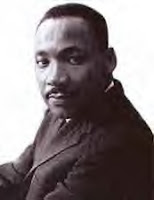
In this speech, King explicitly accepted his role as a preacher. He delivered his message with the force of convictions that he lived. Please follow the link above to his brilliant, moving, and still relevant speech. I like this photograph because he seems to be looking at us. Let's learn the lesson our King taught us: listen to your conscience.

Sunday, January 14, 2007

iNewton

If anyone other than Apple announced a new cell phone, nobody would pay much attention. Improbably, Apple not only met, but actually exceeded enormous expectations when it announced the iPhone (figure). What CEO Steve Jobs demonstrated was clear evidence that they had thought deeply about how a phone should work. We all have phones with functions that we've never managed to figure out how to use. Or, having finally figured out how to do something by reading the manual or touring the menus, we forgot the trick by the next time. Apple has applied its design magic to the physical form and the human “interface”, making a phone that looks great and works the way you'd expect.

Full disclosure: I own a little – too little – Apple stock. I also own a little – enough – Motorola stock. I've always admired Moto's advanced technology and, lately, its style. Unfortunately, its phones have often been marred by mediocre software. Also, all cell phones have been crippled by the telephone service providers because the carriers want to sell their own services. Apple, in contrast, had the clout to get Cingular/ATT to actually add support for functions. Oddly, the iPhone has been criticized (already) for not allowing even more, "third party" applications. This criticism is silly because the iPhone comes with standard applications that are years ahead of the competition and because nobody adds applications to their iPod or current cell phone, anyway.

I was hoping for an ultraportable tablet computer from Apple. I figured, who needs another phone? Well, the new iPhone is essentially an updated Newton (lower figure), a small tablet/personal data assistant (PDA) that was way ahead of it time when Apple produced it over a decade years ago. The Newton didn't have cell phone, wireless internet, or bluetooth (short range) connections. There's a very good reason why these were missing on the Newton: they either rare (cell phones) or non-existent at the time. I had one and despite its limitations, the Newton was still a very useful device. Now the iPhone is the Newton, perfected. iWant.

Sunday, December 31, 2006

Terrorism by any Other Name

If an Iranian warship shot down an American airliner, how would Americans* respond? With outrage and a desire for retribution, surely. Now, reverse the nationalities and remove the hypothetical and you can imagine how the Iranians feel about us.

On July 3, 1988 the American cruiser USS Vincennes shot down an Iran Air airliner, killing 290 civilians, including 66 children.

The US first claimed that the airplane was actually a fighter attacking the cruiser. The wreckage and radar logs soon made it clear that the plane was a commercial airliner on a scheduled flight. George the First (Bush) defended the shoot-down and said "I will never apologize for the United States of America — I don't care what the facts are" (like father, like son). The sailors on the Vincennes were awarded combat-action ribbons. Eventually, the US government paid reparations, tacitly admitting culpability.

This was not “terrorism”, because the US Navy and government had no intention of killing these people. However, the captain had developed a reputation among his peers as being overly aggressive, earning for his ship the mocking nickname “robocruiser”. When inappropriate behavior is so widely recognized, those in command should be aware of the problem and it is their duty to act. (A parallel could be drawn with the Abu Grahib prisoner abuse scandal.) When they fail to exercise their responsibility, and deny the facts of the consequences, then their behavior effectively mirrors the terrorists'.

Americans, if they know anything of our troubled history with Iran, are vaguely aware of CIA support for the Shah, a brutal dictator, from the '50s to the '70s, the yearlong hostage crisis under Carter, and the Iran-contra imbroglio under Reagan. We should be reminded occasionally of the reasons why Iran might rationally fear us. Such a reminder might check our self-righteousness.

*The government-media-public triangle is more complex than "tail wagging the dog". The government ignores or ingratiates itself with the news media; the media arcs from lionizing to pillorying politicians while harping or pandering to the public; the public can make-or-break politicians and media, but is so misled and misinformed that it responds slowly and then acts capriciously.

Thursday, December 21, 2006

Round Trip


Ellipsoid, actually. We turn the corner tonight at 22 minutes after midnight (UTC, formerly known as GMT).

Saturday, December 16, 2006

The Holocaust?

Iran hosted a meeting bringing together many leading doubters of the Holocaust. This sad group disputes the historical record that millions of Jews were killed in the Nazi death camps.

The evidence of the Jewish Holocaust is overwhelming. One must believe either (1) the massive evidence from many diverse and seemingly unimpeachable sources or (2) it is a vast conspiracy. Have the conspiracy theorists ever presented a plausible motive? Justifying the formation of a Jewish state (Israel) isn't logical because the conspiracy must include non-Zionists and even anti-Zionists.

I once talked with an old man who believed the Jews were not killed but rather died in the camps from typhus, which actually is a scourge of overcrowded and underfed populations. The experience was particularly disturbing because he was clearly very intelligent and educated. He never claimed personal experience that countered the historical record, though naturally I wonder what he did in the war. He did not present a motive for the conspiracy and, after a spirited (albeit increasingly uncomfortable) half hour of conversation, the remainder of the 7 hour flight was silent.

I have visited Dachau and Auschwitz, two of the most notorious death camps. It is a numbing and challenging experience: numbing because the depth of the horror is unfathomable and challenging because the scale of the process demonstrates our human capacity to systematize and normalize even the most loathsome behavior.

Let us never forget the millions of Jews killed in the Holocaust. And let us also remember the many non-Jews killed because they were political opponents, homosexuals, gypsies, or because their homes were designated as “living room” (lebensraum) for Nazis. We naturally sympathize and identify with the victims. However, most importantly, we must guard against the stereotyping and vilification that led people like us to commit or tolerate these horrors.

Sunday, December 10, 2006

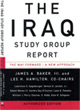
Iraq Study Group: can you handle the truth?


The Iraq Study Group (ISG) report clearly states what anyone paying attention has known for some time: the situation in Iraq is dire and getting worse. It's a miracle that a bipartisan group could be so blunt. Bush performed his now-familiar routine, thanking the members of a panel for a study he didn't want, for news he doesn't understand, and for advice he won't follow. A few people want to shoot the messengers, calling the ISG members “surrender monkeys” and worse. Unfortunately, these people are the same fools who have supported Bush from the beginning, in other words, his political base. Nothing in Bush's political character indicates that he could ignore his base for any reason, even if he understood and accepted the ISG's conclusions.

Others are saying that we owe the Iraqis a strong effort to right the situation. They favor the definition of clear and achievable goals for the Iraqi government. They think such an effort would prevent any subsequent claim that we lost only because we gave up. This is the same argument that others still make about Vietnam. It's a little late to be defining goals. But the main problem with this approach is that it's twin goals are antagonistic: last chance efforts do not inspire the courage required to prevail.

There is even talk of replacing the Iraqi government. So much for democracy. The advocates of this approach are the most unrealistic: it's not like the Iraqis have Diebold electronic voting machines that make it easy to steal elections in Florida, Ohio, etc. Those purple fingers! So colorful, so dramatic, so nettlesome.